*This model was published in HF papers on 2022-06-17 and contributed to Hugging Face Transformers on 2023-01-25.*
# BridgeTower
## Overview
The BridgeTower model was proposed in [BridgeTower: Building Bridges Between Encoders in Vision-Language Representative Learning](https://huggingface.co/papers/2206.08657) by Xiao Xu, Chenfei Wu, Shachar Rosenman, Vasudev Lal, Wanxiang Che, Nan Duan. The goal of this model is to build a
bridge between each uni-modal encoder and the cross-modal encoder to enable comprehensive and detailed interaction at each layer of the cross-modal encoder thus achieving remarkable performance on various downstream tasks with almost negligible additional performance and computational costs.
This paper has been accepted to the [AAAI'23](https://aaai.org/Conferences/AAAI-23/) conference.
The abstract from the paper is the following:
*Vision-Language (VL) models with the TWO-TOWER architecture have dominated visual-language representation learning in recent years.
Current VL models either use lightweight uni-modal encoders and learn to extract, align and fuse both modalities simultaneously in a deep cross-modal encoder, or feed the last-layer uni-modal representations from the deep pre-trained uni-modal encoders into the top cross-modal encoder.
Both approaches potentially restrict vision-language representation learning and limit model performance. In this paper, we propose BRIDGETOWER, which introduces multiple bridge layers that build a connection between the top layers of uni-modal encoders and each layer of the crossmodal encoder.
This enables effective bottom-up cross-modal alignment and fusion between visual and textual representations of different semantic levels of pre-trained uni-modal encoders in the cross-modal encoder. Pre-trained with only 4M images, BRIDGETOWER achieves state-of-the-art performance on various downstream vision-language tasks.
In particular, on the VQAv2 test-std set, BRIDGETOWER achieves an accuracy of 78.73%, outperforming the previous state-of-the-art model METER by 1.09% with the same pre-training data and almost negligible additional parameters and computational costs.
Notably, when further scaling the model, BRIDGETOWER achieves an accuracy of 81.15%, surpassing models that are pre-trained on orders-of-magnitude larger datasets.*
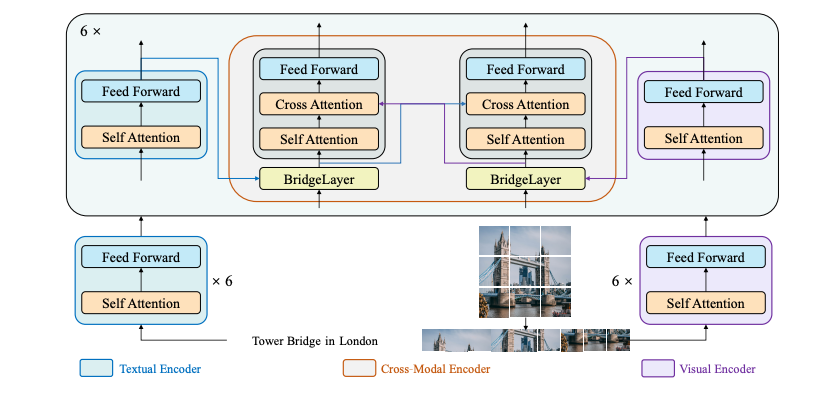 BridgeTower architecture. Taken from the original paper.
This model was contributed by [Anahita Bhiwandiwalla](https://huggingface.co/anahita-b), [Tiep Le](https://huggingface.co/Tile) and [Shaoyen Tseng](https://huggingface.co/shaoyent). The original code can be found [here](https://github.com/microsoft/BridgeTower).
## Usage tips and examples
BridgeTower consists of a visual encoder, a textual encoder and cross-modal encoder with multiple lightweight bridge layers.
The goal of this approach was to build a bridge between each uni-modal encoder and the cross-modal encoder to enable comprehensive and detailed interaction at each layer of the cross-modal encoder.
In principle, one can apply any visual, textual or cross-modal encoder in the proposed architecture.
The [`BridgeTowerProcessor`] wraps [`RobertaTokenizer`] and [`BridgeTowerImageProcessor`] into a single instance to both
encode the text and prepare the images respectively.
The following example shows how to run contrastive learning using [`BridgeTowerProcessor`] and [`BridgeTowerForContrastiveLearning`].
```python
import requests
from PIL import Image
from transformers import BridgeTowerForContrastiveLearning, BridgeTowerProcessor
url = "http://images.cocodataset.org/val2017/000000039769.jpg"
image = Image.open(requests.get(url, stream=True).raw)
texts = ["An image of two cats chilling on a couch", "A football player scoring a goal"]
processor = BridgeTowerProcessor.from_pretrained("BridgeTower/bridgetower-large-itm-mlm-itc")
model = BridgeTowerForContrastiveLearning.from_pretrained("BridgeTower/bridgetower-large-itm-mlm-itc", device_map="auto")
# forward pass
scores = dict()
for text in texts:
# prepare inputs
encoding = processor(image, text, return_tensors="pt").to(model.device)
outputs = model(**encoding)
scores[text] = outputs
```
The following example shows how to run image-text retrieval using [`BridgeTowerProcessor`] and [`BridgeTowerForImageAndTextRetrieval`].
```python
import requests
from PIL import Image
from transformers import BridgeTowerForImageAndTextRetrieval, BridgeTowerProcessor
url = "http://images.cocodataset.org/val2017/000000039769.jpg"
image = Image.open(requests.get(url, stream=True).raw)
texts = ["An image of two cats chilling on a couch", "A football player scoring a goal"]
processor = BridgeTowerProcessor.from_pretrained("BridgeTower/bridgetower-base-itm-mlm")
model = BridgeTowerForImageAndTextRetrieval.from_pretrained("BridgeTower/bridgetower-base-itm-mlm", device_map="auto")
# forward pass
scores = dict()
for text in texts:
# prepare inputs
encoding = processor(image, text, return_tensors="pt").to(model.device)
outputs = model(**encoding)
scores[text] = outputs.logits[0, 1].item()
```
The following example shows how to run masked language modeling using [`BridgeTowerProcessor`] and [`BridgeTowerForMaskedLM`].
```python
from transformers import BridgeTowerProcessor, BridgeTowerForMaskedLM
from PIL import Image
import requests
url = "http://images.cocodataset.org/val2017/000000360943.jpg"
image = Image.open(requests.get(url, stream=True).raw).convert("RGB")
text = "a looking out of the window"
processor = BridgeTowerProcessor.from_pretrained("BridgeTower/bridgetower-base-itm-mlm")
model = BridgeTowerForMaskedLM.from_pretrained("BridgeTower/bridgetower-base-itm-mlm", device_map="auto")
# prepare inputs
encoding = processor(image, text, return_tensors="pt").to(model.device)
# forward pass
outputs = model(**encoding)
results = processor.decode(outputs.logits.argmax(dim=-1).squeeze(0).tolist())
print(results)
.a cat looking out of the window.
```
Tips:
- This implementation of BridgeTower uses [`RobertaTokenizer`] to generate text embeddings and OpenAI's CLIP/ViT model to compute visual embeddings.
- Checkpoints for pre-trained [bridgeTower-base](https://huggingface.co/BridgeTower/bridgetower-base) and [bridgetower masked language modeling and image text matching](https://huggingface.co/BridgeTower/bridgetower-base-itm-mlm) are released.
- Please refer to [Table 5](https://huggingface.co/papers/2206.08657) for BridgeTower's performance on Image Retrieval and other down stream tasks.
## BridgeTowerConfig
[[autodoc]] BridgeTowerConfig
## BridgeTowerTextConfig
[[autodoc]] BridgeTowerTextConfig
## BridgeTowerVisionConfig
[[autodoc]] BridgeTowerVisionConfig
## BridgeTowerImageProcessor
[[autodoc]] BridgeTowerImageProcessor
- preprocess
## BridgeTowerImageProcessorPil
[[autodoc]] BridgeTowerImageProcessorPil
- preprocess
## BridgeTowerProcessor
[[autodoc]] BridgeTowerProcessor
- __call__
## BridgeTowerModel
[[autodoc]] BridgeTowerModel
- forward
## BridgeTowerForContrastiveLearning
[[autodoc]] BridgeTowerForContrastiveLearning
- forward
## BridgeTowerForMaskedLM
[[autodoc]] BridgeTowerForMaskedLM
- forward
## BridgeTowerForImageAndTextRetrieval
[[autodoc]] BridgeTowerForImageAndTextRetrieval
- forward
BridgeTower architecture. Taken from the original paper.
This model was contributed by [Anahita Bhiwandiwalla](https://huggingface.co/anahita-b), [Tiep Le](https://huggingface.co/Tile) and [Shaoyen Tseng](https://huggingface.co/shaoyent). The original code can be found [here](https://github.com/microsoft/BridgeTower).
## Usage tips and examples
BridgeTower consists of a visual encoder, a textual encoder and cross-modal encoder with multiple lightweight bridge layers.
The goal of this approach was to build a bridge between each uni-modal encoder and the cross-modal encoder to enable comprehensive and detailed interaction at each layer of the cross-modal encoder.
In principle, one can apply any visual, textual or cross-modal encoder in the proposed architecture.
The [`BridgeTowerProcessor`] wraps [`RobertaTokenizer`] and [`BridgeTowerImageProcessor`] into a single instance to both
encode the text and prepare the images respectively.
The following example shows how to run contrastive learning using [`BridgeTowerProcessor`] and [`BridgeTowerForContrastiveLearning`].
```python
import requests
from PIL import Image
from transformers import BridgeTowerForContrastiveLearning, BridgeTowerProcessor
url = "http://images.cocodataset.org/val2017/000000039769.jpg"
image = Image.open(requests.get(url, stream=True).raw)
texts = ["An image of two cats chilling on a couch", "A football player scoring a goal"]
processor = BridgeTowerProcessor.from_pretrained("BridgeTower/bridgetower-large-itm-mlm-itc")
model = BridgeTowerForContrastiveLearning.from_pretrained("BridgeTower/bridgetower-large-itm-mlm-itc", device_map="auto")
# forward pass
scores = dict()
for text in texts:
# prepare inputs
encoding = processor(image, text, return_tensors="pt").to(model.device)
outputs = model(**encoding)
scores[text] = outputs
```
The following example shows how to run image-text retrieval using [`BridgeTowerProcessor`] and [`BridgeTowerForImageAndTextRetrieval`].
```python
import requests
from PIL import Image
from transformers import BridgeTowerForImageAndTextRetrieval, BridgeTowerProcessor
url = "http://images.cocodataset.org/val2017/000000039769.jpg"
image = Image.open(requests.get(url, stream=True).raw)
texts = ["An image of two cats chilling on a couch", "A football player scoring a goal"]
processor = BridgeTowerProcessor.from_pretrained("BridgeTower/bridgetower-base-itm-mlm")
model = BridgeTowerForImageAndTextRetrieval.from_pretrained("BridgeTower/bridgetower-base-itm-mlm", device_map="auto")
# forward pass
scores = dict()
for text in texts:
# prepare inputs
encoding = processor(image, text, return_tensors="pt").to(model.device)
outputs = model(**encoding)
scores[text] = outputs.logits[0, 1].item()
```
The following example shows how to run masked language modeling using [`BridgeTowerProcessor`] and [`BridgeTowerForMaskedLM`].
```python
from transformers import BridgeTowerProcessor, BridgeTowerForMaskedLM
from PIL import Image
import requests
url = "http://images.cocodataset.org/val2017/000000360943.jpg"
image = Image.open(requests.get(url, stream=True).raw).convert("RGB")
text = "a looking out of the window"
processor = BridgeTowerProcessor.from_pretrained("BridgeTower/bridgetower-base-itm-mlm")
model = BridgeTowerForMaskedLM.from_pretrained("BridgeTower/bridgetower-base-itm-mlm", device_map="auto")
# prepare inputs
encoding = processor(image, text, return_tensors="pt").to(model.device)
# forward pass
outputs = model(**encoding)
results = processor.decode(outputs.logits.argmax(dim=-1).squeeze(0).tolist())
print(results)
.a cat looking out of the window.
```
Tips:
- This implementation of BridgeTower uses [`RobertaTokenizer`] to generate text embeddings and OpenAI's CLIP/ViT model to compute visual embeddings.
- Checkpoints for pre-trained [bridgeTower-base](https://huggingface.co/BridgeTower/bridgetower-base) and [bridgetower masked language modeling and image text matching](https://huggingface.co/BridgeTower/bridgetower-base-itm-mlm) are released.
- Please refer to [Table 5](https://huggingface.co/papers/2206.08657) for BridgeTower's performance on Image Retrieval and other down stream tasks.
## BridgeTowerConfig
[[autodoc]] BridgeTowerConfig
## BridgeTowerTextConfig
[[autodoc]] BridgeTowerTextConfig
## BridgeTowerVisionConfig
[[autodoc]] BridgeTowerVisionConfig
## BridgeTowerImageProcessor
[[autodoc]] BridgeTowerImageProcessor
- preprocess
## BridgeTowerImageProcessorPil
[[autodoc]] BridgeTowerImageProcessorPil
- preprocess
## BridgeTowerProcessor
[[autodoc]] BridgeTowerProcessor
- __call__
## BridgeTowerModel
[[autodoc]] BridgeTowerModel
- forward
## BridgeTowerForContrastiveLearning
[[autodoc]] BridgeTowerForContrastiveLearning
- forward
## BridgeTowerForMaskedLM
[[autodoc]] BridgeTowerForMaskedLM
- forward
## BridgeTowerForImageAndTextRetrieval
[[autodoc]] BridgeTowerForImageAndTextRetrieval
- forward