 06f1fd69a6
5.6 KiB
This model was published in HF papers on 2024-06-13 and contributed to Hugging Face Transformers on 2024-07-05.
Depth Anything V2
Overview
Depth Anything V2 was introduced in the paper of the same name by Lihe Yang et al. It uses the same architecture as the original Depth Anything model, but uses synthetic data and a larger capacity teacher model to achieve much finer and robust depth predictions.
The abstract from the paper is the following:
This work presents Depth Anything V2. Without pursuing fancy techniques, we aim to reveal crucial findings to pave the way towards building a powerful monocular depth estimation model. Notably, compared with V1, this version produces much finer and more robust depth predictions through three key practices: 1) replacing all labeled real images with synthetic images, 2) scaling up the capacity of our teacher model, and 3) teaching student models via the bridge of large-scale pseudo-labeled real images. Compared with the latest models built on Stable Diffusion, our models are significantly more efficient (more than 10x faster) and more accurate. We offer models of different scales (ranging from 25M to 1.3B params) to support extensive scenarios. Benefiting from their strong generalization capability, we fine-tune them with metric depth labels to obtain our metric depth models. In addition to our models, considering the limited diversity and frequent noise in current test sets, we construct a versatile evaluation benchmark with precise annotations and diverse scenes to facilitate future research.
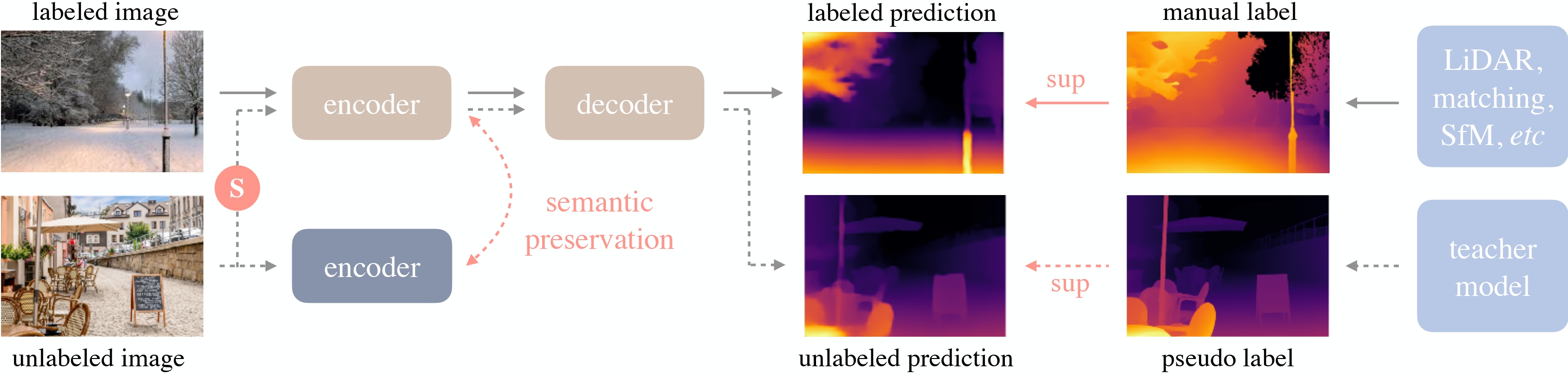
Depth Anything overview. Taken from the original paper.
The Depth Anything models were contributed by nielsr. The original code can be found here.
Usage example
There are 2 main ways to use Depth Anything V2: either using the pipeline API, which abstracts away all the complexity for you, or by using the DepthAnythingForDepthEstimation class yourself.
Pipeline API
The pipeline allows to use the model in a few lines of code:
import requests
from PIL import Image

from transformers import pipeline


# load pipe
pipe = pipeline(task="depth-estimation", model="depth-anything/Depth-Anything-V2-Small-hf")

# load image
url = 'http://images.cocodataset.org/val2017/000000039769.jpg'
image = Image.open(requests.get(url, stream=True).raw)

# inference
depth = pipe(image)["depth"]
Using the model yourself
If you want to do the pre- and post-processing yourself, here's how to do that:
import requests
import torch
from PIL import Image

from transformers import AutoImageProcessor, AutoModelForDepthEstimation


url = "http://images.cocodataset.org/val2017/000000039769.jpg"
image = Image.open(requests.get(url, stream=True).raw)

image_processor = AutoImageProcessor.from_pretrained("depth-anything/Depth-Anything-V2-Small-hf")
model = AutoModelForDepthEstimation.from_pretrained("depth-anything/Depth-Anything-V2-Small-hf", device_map="auto")

# prepare image for the model
inputs = image_processor(images=image, return_tensors="pt").to(model.device)

with torch.no_grad():
    outputs = model(**inputs)

# interpolate to original size and visualize the prediction
post_processed_output = image_processor.post_process_depth_estimation(
    outputs,
    target_sizes=[(image.height, image.width)],
)

predicted_depth = post_processed_output[0]["predicted_depth"]
depth = (predicted_depth - predicted_depth.min()) / (predicted_depth.max() - predicted_depth.min())
depth = depth.detach().cpu().numpy() * 255
depth = Image.fromarray(depth.astype("uint8"))
Resources
A list of official Hugging Face and community (indicated by 🌎) resources to help you get started with Depth Anything.
- Monocular depth estimation task guide
- Depth Anything V2 demo.
- A notebook showcasing inference with [
DepthAnythingForDepthEstimation] can be found here. 🌎 - Core ML conversion of the
smallvariant for use on Apple Silicon.
If you're interested in submitting a resource to be included here, please feel free to open a Pull Request and we'll review it! The resource should ideally demonstrate something new instead of duplicating an existing resource.
DepthAnythingConfig
autodoc DepthAnythingConfig
DepthAnythingForDepthEstimation
autodoc DepthAnythingForDepthEstimation - forward